

Astrophysics · Cosmic Dawn Center

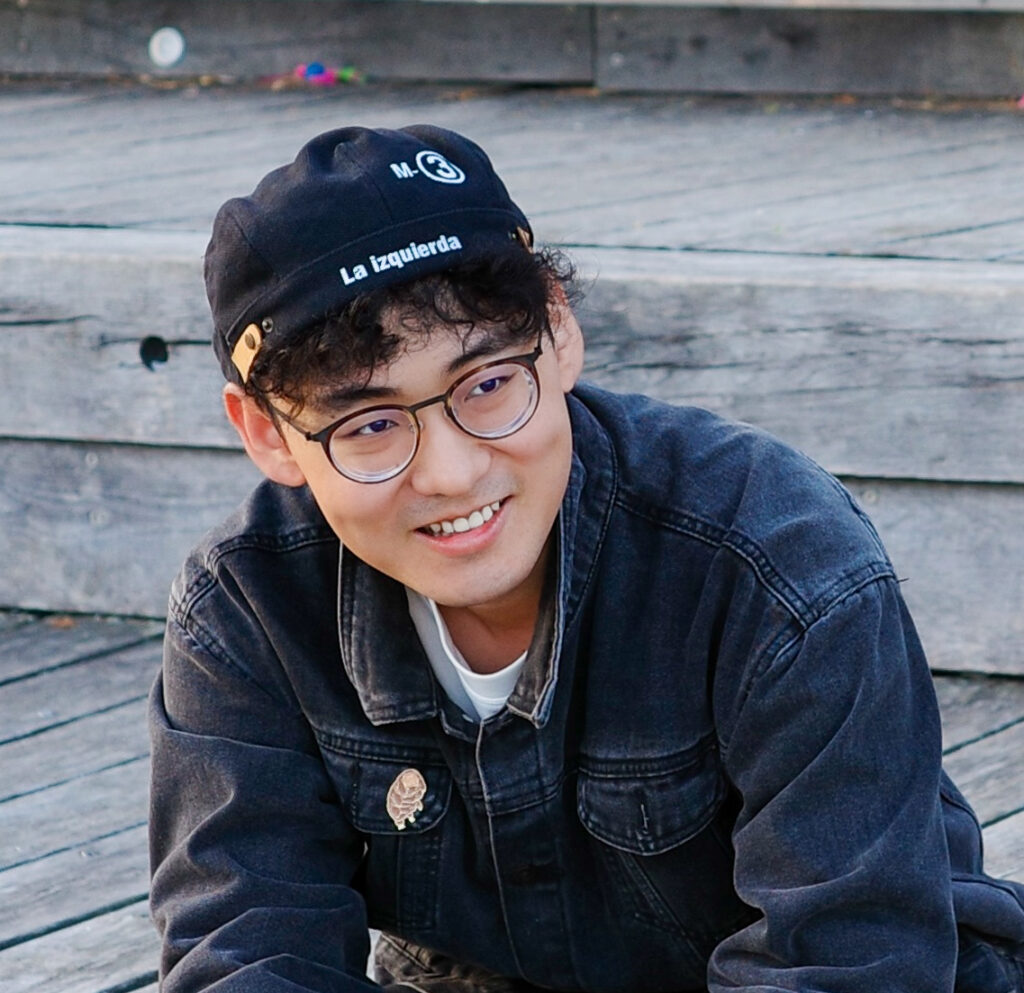
Pengpei Zhu 朱芃佩

Galaxies, gas & cosmic history.

I study how galaxies grow, enrich their stars, and stop forming new ones — reading their histories through the light they leave behind.

DTUCosmic Dawn Center
Pengpei Zhu
PhD researcherDAWN · DTU Space, Denmark
penzhu@space.dtu.dk

01About me

A little of my story

Hello, I’m
Pengpei.

An astronomer interested in how galaxies grow — and why they stop forming stars.

I’m Pengpei Zhu 朱芃佩, a PhD student at the Cosmic Dawn Center, DTU Space in Denmark, supervised by Francesco Valentino. I study galaxy evolution through neutral gas flows, stellar populations, and chemical enrichment.

My path began at the University of California, Santa Cruz, where I studied physics with an astrophysics focus and philosophy. I then completed a master’s in astronomy at Leiden University before joining DAWN in 2024. Today, I work with JWST, VLT, and Keck spectra to connect the light of galaxies with their physical histories.

  1. 2017–2022 · Santa CruzPhysics & Philosophy

    BS & BA · UC Santa Cruz

  2. 2022–2024 · LeidenAstronomy

    MSc · Leiden University

  3. 2024–present · DenmarkAstrophysics

    PhD · Cosmic Dawn Center, DTU

02Research

From spectra to physical histories

Research

What makes a galaxy go quiet?

I connect the motion of gas, the chemistry of stars, and the histories of star formation to understand galaxy evolution and quenching. My work combines spectroscopy with tools that make the evidence easier to explore.

01 / Stellar metallicities

The chemical memory of galaxies

Ongoing · JWST/NIRSpec

What can stars tell us about a galaxy’s formation?

I study the stellar metallicities of massive quiescent galaxies at high redshift. Absorption-line measurements let us connect their enrichment histories with nearby populations studied by SDSS and LEGA-C.

I develop tools for stellar-population modelling and uncertainty estimation, extracting physical information from faint spectral features. The goal is to connect the chemical record preserved in stars with the histories of galaxy growth and quenching.

With Anna Gallazzi, Stefano Zibetti, Francesco Valentino, and Kei Ito. Stellar-population studies in preparation.

02 / Neutral gas flows

Gas leaving. Gas returning?

DeepDive · Published 2026

How do galaxies remain quiet?

Using sodium absorption in JWST spectra, I investigate neutral gas outflows in distant quiescent galaxies. Their inferred velocities suggest that gas can remain bound and return, offering a window onto how galaxies stay quiet.

The DeepDive sample connects the motion of neutral gas with the properties of massive galaxies after star formation has declined. These observations help us investigate the role of gas cycling in maintaining quiescence.

Read the DeepDive paper
A view from the data
Neutral gas in galaxies with little star formation. Star formation rate versus stellar mass and gas velocity offset. Original figure from Zhu et al. (2026), Fig. 3. Symbols and uncertainties retain the paper’s definitions.

03 / Post-starburst galaxies

Cold gas, little star formation

SQuIGGLE · Keck/NIRES

Can a galaxy stop forming stars while retaining its fuel?

My work on gas-rich post-starburst galaxies uses Hα spectroscopy to test their ongoing star formation, connecting the gas reservoir to the process of quenching.

Within SQuIGGLE, I use Keck/NIRES observations to examine the relationship between molecular gas and star formation after a recent burst. This work investigates why a substantial reservoir of gas does not necessarily imply vigorous ongoing star formation.

Read the SQuIGGLE paper

04 / Spectra & open catalogues

Making complex spectra interpretable

Methods · VLT/MUSE & archives

How can we make the evidence behind a measurement easier to examine?

For my master’s work on NGC 833 and NGC 835, I developed methods to select multicomponent emission-line models using spatial, physical, and statistical information from MUSE datacubes.

I am now developing an interactive catalogue for my stellar-metallicity study and a DJA-based catalogue of red spiral galaxies at z > 1. These tools link measurements to spectra, model comparisons, diagnostics, and sample-selection information.

Catalogues in development, with structured data and clear provenance for future reuse.

Publications

Selected work on gas flows, quenching, and galaxy dynamics, alongside publications with the DeepDive and SQuIGGLE collaborations.

My publication listExplore all papers on SciX

19 publications and preprints, matched to SciX · Updated 12 November 2026.

3 publications selectedSciX bibliography · 12 November 2026

2026First author

There and Back Again: Neutral Outflows in z ∼ 3.5 Quiescent Galaxies

Pengpei Zhu, Kei Ito, Francesco Valentino, et al.

Astronomy & Astrophysics 712, A169

JWST spectroscopy reveals neutral gas outflows in distant quiescent galaxies. Their inferred velocities suggest that much of the gas may return to the host, linking gas recycling to the maintenance of quiescence.

2025First author

SQuIGGLE: Observational Evidence of Low Ongoing Star Formation Rates in Gas-rich Post-starburst Galaxies

Pengpei Zhu, Katherine A. Suess, Mariska Kriek, et al.

The Astrophysical Journal 981, 60

Keck/NIRES spectra confirm low ongoing star formation in gas-rich post-starburst galaxies, showing that quenching can precede the depletion of cold gas.

2022Coauthor

Different Formation Scenarios for Counterrotating Stellar Disks in Nearby Galaxies

Min Bao, Yanmei Chen, Pengpei Zhu, et al.

The Astrophysical Journal Letters 926, L13

A study of counterrotating stellar disks with MaNGA, connecting their formation to gas supply and angular-momentum evolution.

For full author lists and the latest publication status, follow the journal and arXiv links. View ORCID

04Interactive projects

Explore
the science.

What can a galaxy’s light tell us?

Try a few examples here, or open a full lab to change the model parameters and explore the results.

Compare the UVJ colours of three reference galaxy groups from Suess et al. (2021).

Open full lab (opens in a new tab)

Loading preview…

05Presentations

Talks & Posters

  1. ePoster

    There and back again? Neutral outflows in z ∼ 3.5 quiescent galaxies

    EAS Annual Meeting 2026

    Lausanne, Switzerland ·

  2. 5 min

    Flash talk

    GalFirenze 2026

    Florence, Italy ·

  3. Contributed talk · 15 min

    DeepDive: Neutral gas outflows in z ∼ 3.5 quiescent galaxies

    Charting Cosmic Dawn in Copenhagen

    Helsingør, Denmark ·

  4. Contributed talk · 7 min

    DeepDive: Neutral gas outflows in z ∼ 3.5 quiescent galaxies

    Tokyo JWST 2026

    Tokyo, Japan ·

  5. Poster

    Neutral gas outflows in z ∼ 3.5 quiescent galaxies

    Annual Danish Astronomy Meeting 2025

    Børkop, Denmark ·

06Astrophotos

Under the same sky

Astrophotos

Looking up, beyond the spectra.

A selection of my recent astrophotography — star trails, interstellar dust, and quiet moments under the night sky. Select a photograph to take a closer look.

Photographs by Pengpei Zhu 朱芃佩

07Curriculum vitae

A path through astronomy

Curriculum
vitae

From astrophysics and philosophy at Santa Cruz to spectroscopy at Leiden and galaxy evolution at DAWN.

Download full CV ↓

PDF · 3 pages · Updated 12 November 2026

Education

  1. 2024 — present

    PhD in Astrophysics

    Cosmic Dawn Center · DTU Space

    Supervisor: Francesco Valentino
  2. 2022 — 2024

    MSc in Astronomy

    Leiden University, the Netherlands

    Astronomy Research programme
  3. 2017 — 2022

    BS in Physics & BA in Philosophy

    University of California, Santa Cruz

    Astrophysics and philosophy of science

Recognition

KHMW Young Talent Award Astronomy master’s thesis prize · 2024

UCSC Dean’s ScholarshipUndergraduate studies

Community

DTU Space PhD CommitteeMember · 2026–2027

DAWN Summit 2025Scientific Organizing Committee

Public observing at LeidenL.A.D. “F. Kaiser” · 2022–2023

08Contact

Ideas are better shared

Let’s talk
about galaxies.

For research discussions, collaborations, or questions about my work, the best way to reach me is by email.

Based at

Cosmic Dawn Center

DTU Space
Technical University of Denmark
Kgs. Lyngby, Denmark

From around the world

Visitors

A little map of where our paths cross.

Visitor map

Coming soon · A place for MapMyVisitors.

About MapMyVisitors

DeepDive · Neutral gas outflows

Expanded original DeepDive figure comparing star formation rate with stellar mass and gas velocity offset.

Original figure from Zhu et al. (2026), Fig. 3. Open full-resolution image

Star trails above an observatory dome

Curving star trails across a blue sky above a small observatory dome and leafless branches.